Stories and news
Nature Strikes Hard: European Vineyards' Devastation and Recovery
The situation becomes particularly critical when nature strikes hard. The global agricultural sector is increasingly exposed to the impacts of climate change.
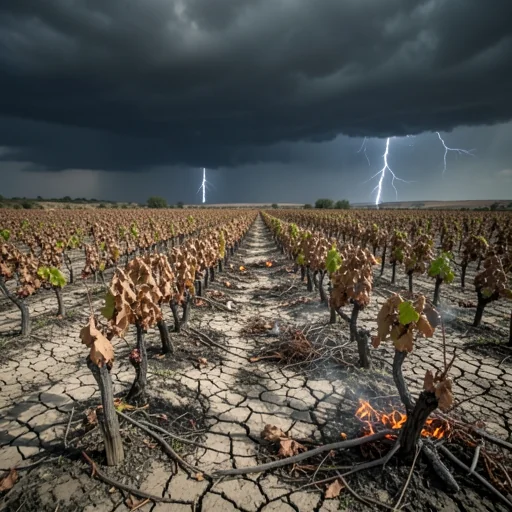
The global agricultural sector is increasingly exposed to the impacts of climate change. Viticulture, with its deep roots in tradition and terroir, is no exception. Extreme weather events, the emergence of new pests and growing pressure on essential infrastructure are redefining the challenges for wine producers. The situation becomes particularly critical when nature strikes hard. Yet, amid these difficulties, unexpected stories of resilience and the opening of new opportunities for regions once considered marginal are also emerging. The experiences of European vineyards are contrasting, from sudden devastation to surprising abundance, and outline a constantly evolving landscape.
At the Rabastens winery in the Tarn, the only glycol refrigeration unit stopped on 2 September.
When Nature Strikes Hard: Between Devastation and New Pests
Nature has manifested forcefully in several regions, bringing immediate destruction and unforeseen challenges. In Pomas, in the Aude, a violent tornado on 24 August devastated the home and cellar of Sofi Bataillard and Julien Veyret of Plateau du Cascal, destroying two thirds of their harvest already in vats and rendering vital equipment like the press and fermentation tanks unusable. This event highlighted the physical vulnerability of wine-making infrastructure in the face of increasingly frequent extreme weather phenomena.
At the same time, elsewhere, high temperatures accelerated vegetative cycles, upending traditional calendars. Harvesting at Domaine Montemagni in Patrimonio, Corsica, began on 4 August. This record earliness caused panic over the simultaneous ripening of all the grapes. This acceleration favored the appearance of new pests, such as Cryptoblabes gnidiella. Its larvae attacked about one vine in ten in some plots. The African leafhopper (Jacobiasca lybica) intensified late in the season. In some areas up to 1,500 adults were caught per trap per week, causing scorching on leaves and halting grape ripening.
Adapting to the Climate Crisis: Infrastructure under Stress and Creative Solutions
Changed climatic conditions, characterized by warmer nights and earlier harvests, have severely tested wineries’ critical infrastructure. In particular, cooling systems have suffered. At the Rabastens winery in the Tarn, the only glycol refrigeration unit stopped on 2 September. This interrupted the cooling of six white wine tanks. In Saint-Cécile les Vignes in the Vaucluse, director Denis Crespo saw his glycol refrigeration unit fail on 20 August. The breakdown occurred even before the harvests began. This forced him to rent a unit for 13,580 euros for four weeks. He also had to transport 1,500 hectoliters of grapes to another site, at a cost of almost 1,000 euros.
Faced with these interruptions and devastations, the resilience and ingenuity of winegrowers proved essential. The vignerons of Pomas received support from a solidarity network. They stored grapes in colleagues’ cellars. They fermented wines “clean, filtered and exceptionally sulfited” elsewhere thanks to new deposits granted by Customs. The Les Collines de Bourdic winery in the Gard could rely on a fifth unit, intended as a security “joker.” That unit made it possible to save the harvest even though a rented unit broke down after only three and a half days.
New Terroirs and Unexpected Resilience
The wine landscape is transforming, with some regions not traditionally devoted to wine finding new opportunities. Sébastien Arnaud harvested his Chardonnay on 29 August in Normandy. He picked nearly two weeks earlier than in 2025 and a month earlier than in 2024, recording excellent sanitary condition and more advanced ripeness. The first heatwave caused some shatter on Chenin flowers, reducing volume. Grape quality was excellent and the Chenin reached 11.5-12 potential degrees.
This unexpected prosperity in Normandy is attributed to local climatic conditions. Average temperatures were 3-4°C lower than Loire vineyards and mitigated the effects of heatwaves. At the same time, in the Vaucluse, Cédric Roux achieved his yield targets of 100 hl/ha in IGP Principauté d’Orange and 51 hl/ha in AOC Côtes du Rhône for the first time since 2008, thanks to an underground arm of the Ouvèze river that kept his vineyards naturally irrigated. Nicolas Dutour in the Hérault was pessimistic in July about signs of thermal stress on his vines. He then doubled his expectations for Viognier. He attributed the success to good spring budburst after abundant winter rains, further evidence that when nature strikes hard, local conditions and practices can produce surprising resilience.
Lessons from the Field: An Uncertain but Adaptable Future
The recent harvest season painted a complex and at times paradoxical picture. The L’Ormarine cooperative in the Hérault recorded an exceptionally good harvest. It reached a peak of two million bottle equivalents per day on its busiest days. Other operations, like those hit by the tornado in the Aude, face reconstruction that will take months. Pierre Lacube, for example, estimated at least 20,000 euros of material and countless hours of work to completely redo his trellising. This estimate highlights the disparity in recovery paths.
The need for monitoring and long-term strategies is clearer than ever. Concern about vine reserves following the attack of the African leafhopper in Corsica underlines the importance of in-depth studies on the physiological impact of new pests. Such studies are fundamental for future vintages. The success of Norman vineyards includes wines that “resemble what can no longer be made in the Loire.” This success suggests a future in which traditional wine maps could be redrawn. It pushes producers to reconsider both agricultural practices and cultivation locations to adapt to climate change, a future where nature strikes hard but also reveals new possibilities.
Sources:
- “Tout a foutu le camp” avec la tornade, sauf la solidarité… | vitisphere.com
- Vendanges volées par Cryptoblabes et précipitées par la cicadelle… | vitisphere.com
- “Sa puissance au démarrage a fait fondre les câbles d’alimentation… | vitisphere.com
- On a trouvé un vignoble qui n’a pas (trop) souffert du millésime… | vitisphere.com
- Le plein de vin malgré les canicules : “on est au maximum autorisé… | vitisphere.com