Stories and news
Artificial intelligence, Reproducibility and Trust in Wine and Food
Even artificial intelligence is beginning to set culinary trends and shape consumer experiences.
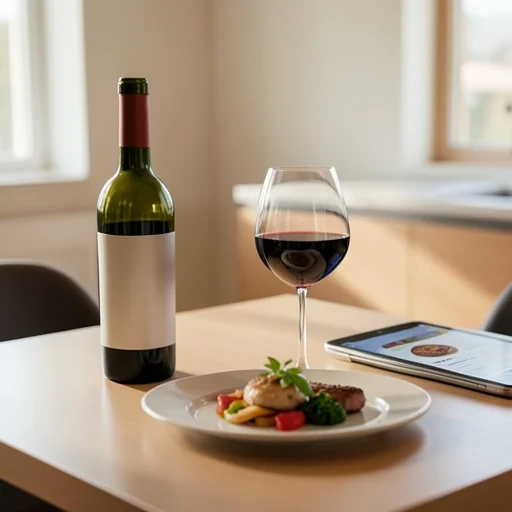
In an age of rapid change, the concept of authenticity and the very definition of “product” are undergoing deep transformations in traditional sectors such as food and wine. From large-scale wine production to the creation of digital content, the demand for extreme personalization and reproducible processes is redefining expectations. This shift toward adaptability and efficiency raises crucial questions about trust and perceived value. In this context even artificial intelligence is beginning to set culinary trends and shape consumer experiences.
Bulk Wine in Mendoza: Flexibility as a Market Strategy
The Argentine region of Mendoza is the second largest wine area in the world with its 140,000 hectares. In this region wine production departs from the romantic image of terroir. Here, the focus is on flexibility and the ability to adapt supply to global demand. Bodega Domiciano produces 20,000 hectoliters of wine a year. It sells half in bulk and the other half bottled, both under its own brands and as private labels for clients. This approach is driven by a pragmatism that responds to a market where margins are tight and competition is high.
Producers in Mendoza do not hesitate to manipulate the profile of their wines to meet specific needs. Federico Fernandez of Bodega Domiciano, as well as Francisco J. Rodríguez of Corbeau Wines, openly explain that their cellar moves about a hundred containers of bulk wine every month. They state they can modify the alcohol, the sugar or the aromatic profile on request. Bulk wine is no longer a fixed product, but a customizable base. Different grape varieties can be added, such as ancellotta, to improve color and structure. Tomas Baistrocchi of Royal Mount highlights that blends of reds and whites are also used to create rosé.
This extreme adaptability is a direct response to market pressures. Royal Mount, with a capacity of 400,000 hectoliters a year, recently signed a contract for 300,000 hectoliters to supply sulphited grape juice to a Chilean buyer, and a new agreement for 200,000 hectoliters is already planned for 2026. The goal is to move volumes and finance the modernization of facilities. The ability to reproduce consistent profiles is essential to reach the mass retail channel. This ability ensures that consumers can repurchase the same wine year after year, a demand for trust and predictability fundamental in wholesale trade.
In the bulk wine business, we don’t talk about soil or climate, we adapt supply to demand.
The Rise and Fall of Digital Credibility
The Argentine wine sector embraces an almost “algorithmic” production model. The world of gastronomy and digital food media faces similar challenges related to authenticity and trust, often aggravated by the use of artificial intelligence. A food influencer was recently criticized for promoting the use of AI to organize dinners. The results proved comically disorienting, such as suggesting a whole peach on a scallop shell. These examples highlight how the application of artificial intelligence to food can generate grotesque approximations, depriving food of its intrinsic visceral appeal.
Trust in the field of food media is already fragile. Influencers, who once dominated the British gastronomic scene with millions of followers, are losing credibility. Despite some lucrative partnerships, many receive little or nothing for their reviews. The main problem is that the excess of positive content and paid advertising has eroded the perception of reliability. Many PR professionals admit confidentially that the heyday of influencers is already over, since their lack of objective critique has damaged their authenticity.
Artificial intelligence promises efficiency and personalization in creating content. Its implementation in food marketing often produces hyper-glossy images and computer-generated menus that inspire horror more than desire. This “culinary sloppiness” generated by AI has been openly criticized, as it fails to evoke the sensory pleasure of real food. To regain trust an exit strategy based on a more critical and expert role seems necessary. Such a role must base opinion on expertise and not on hidden payments.
From Reproducibility of Taste to the Plate Algorithm
The parallel between Argentine wine production and new trends in digital gastronomy is evident in the pursuit of standardized reproducibility. Mendoza producers commit to providing consistent wine profiles and high volumes, regardless of vintage variations or “terroir”. It is common practice to add up to 15% of other grape varieties to a Malbec while maintaining its labeling. Even 3% of sweet wine, like Torrontes, is added to increase sweetness. This ability to engineer flavor responds to a clear commercial necessity, ensuring that the final product is always predictable for large buyers.
Similarly, artificial intelligence applied to restaurant menus or dinner ideas aims at a form of predictability and standardization. However, the results often lack cohesion and appeal, highlighting a disconnection between algorithmic output and the human experience of taste. Mendoza’s tailor-made wine is a tangible product that, even if manipulated, still has to be drinkable and consistent. The “computer-generated approximations” in food risk alienating the consumer, who seeks an authentic experience and not a mere reproduction.
Consumers want to be able to repurchase the same wine. That’s why we must be able to reproduce the same vintages year after year.
Faced with this evolution, restaurants are also seeking new ways to articulate their values and aesthetics. Many are launching their own media verticals, like newsletters, turning storytelling into a “second product” consumable asynchronously. This allows the restaurant to have a voice and to be “readable” beyond the physical meal experience. However, it requires hiring editors or identifying staff members with a resonant voice, a considerable challenge. The question of taste and its description is intrinsically linked to the language we use to receive and describe it. Wine experts suggest that authentic storytelling remains an irreplaceable pillar.
Sources: