Market and export
Wine crisis drives farmers to diversify into almonds, cereals
The wine crisis is pushing farmers and cooperatives to reconsider their future, converting land to alternative crops such as almonds and cereals.
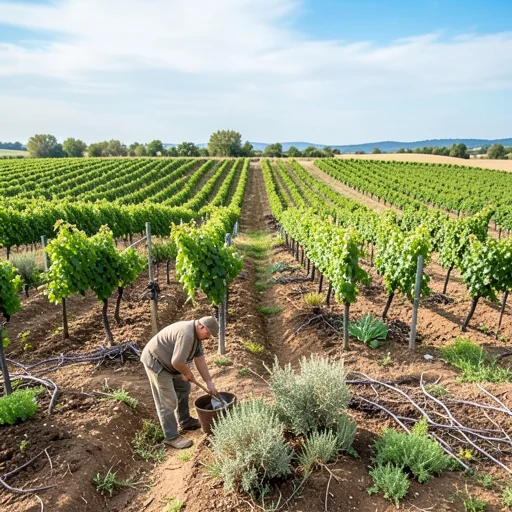
In an era of profound agricultural change, the wine sector faces challenges demanding structural rethink and new strategies. Many producers and cooperatives are exploring diversification paths, driven by the need to ensure the economic sustainability of their activities. They must confront evolving markets and rising production costs. The wine crisis is pushing farmers and cooperatives to reconsider their future, converting land and investing in alternative crops such as almonds and cereals, while the industry seeks to restore a balance between demand and supply and to set fair prices for wine production.
The Wine Crisis and New Agricultural Routes
The drastic drop in revenues is pushing many winegrowers to look for alternatives. Sylvain Belloni, a farmer in the Bouches-du-Rhône, saw the pay for his bunches fall by almost 40% between 2023 and 2024, a direct consequence of falling prices and the reduction of the yield ceiling from 120 to 100 hectoliters per hectare for red and rosé wines. Already in 2012, Belloni had sensed the need to diversify. He planted 1.5 hectares of almond trees. That decision was inspired by his parents’ wisdom: do not “put all your eggs in one basket.”
At the same time, the Vignerons des Coteaux de l’Isle cooperative in Maransin, in the Libournais, has faced an even deeper crisis: this year there will be no vinifications. With only 21 members cultivating 80 hectares, production is insufficient to reopen the cellar. The cooperative’s president chose a radical solution, making the buildings available to a farmer-miller-baker, Éric Apathie. The goal is to turn the space into a sales point for flour and bread. It will also be a site for farm-based dining. This will create a new economic hub for the community.
These examples highlight different but complementary strategies to tackle the crisis. Belloni integrates almonds to “limit the damage.” He seeks an additional income source that reduces wine losses but does not fully compensate them. Apathie proposes an almost total conversion, turning the cooperative into a center for cereals and bakery products. Both paths aim to stabilize farm income in a context of uncertainty. They bet on crops that can offer more stable or growing economic prospects.
The balance between demand and supply is redefining the rural landscape
Vineyard uprooting campaigns have played a crucial role in trying to restore the balance between demand and supply in the wine market. Over the last three years, the quantity of grapes harvested has been below the 10.5 million hectoliters that leave the basin every year, leading to a reduction in available stocks. Fabien Castelbou of InterOc emphasizes that “the balance between demand and supply is therefore well present.” But this market reorganization has left room for new agricultural opportunities in territories previously dominated by viticulture.
Éric Apathie’s project in Maransin fully embodies this transition. The farmer intends to convert an initial tranche of 10 hectares of uprooted vineyards into land for cereals this autumn. The long-term goal is 40-50 hectares. Apathie commits to paying for the cereals at a price 20% higher than that offered by traditional purchasers. He estimates a gross margin of around €1,000 per hectare for the winegrowers. This initiative not only recovers land but also offers local producers a new and more profitable source of income.
Belloni’s diversification into almonds also fits this rebalancing picture. His investment in almond growing has a target: reaching 15 hectares and revenue of €40,000-50,000 within five years. This reflects the search for a long-term alternative. Although the initial investment is significant, with planting costs between €4,400 and €4,800 per hectare, and it takes four or five years for an almond tree to produce, market prospects for almonds remain favorable due to demand still outstripping supply.
The Right Price and Market Challenges
Despite efforts to rebalance supply, the issue of price remains central to the sustainability of the wine sector. According to Fabien Castelbou, the balance of sustainability agreements is “satisfactory halfway through.” There is a decrease in contracted volumes in the lower price bracket for rosés (€80-84/hl). This favors higher brackets (€85-90/hl). However, for red and rosé wines, there is still a shortfall of €3 per hectoliter to cover production costs. This gap is not found for white wines, which are mostly already within the price tunnel.
The other major goal of this second year is to bring large-scale retail together around agreements already shared by cooperative cellars, independent winegrowers and market operators.
This shortfall, although “completely painless for the final consumer,” is crucial for producers. The wine industry seeks to involve large-scale retail in the agreements. It argues that wine is not immune to inflationary trends. Production costs must also be recognized. The “sole law of the market” may not be enough to guarantee fair prices. Other solutions will be necessary, because viticulture influences the vitality of landscapes and territories.
The transition to new crops offers a model, such as wheat and bread in Maransin. In this model, prices are set above market level, guaranteeing better margins for producers. Similarly, Sylvain Belloni’s almond growing generated €10,000 in 2024 from a young orchard. It is seen as a “long-term investment.” Demand still exceeds supply in this market. These examples show that the wine sector is struggling for profitability. Diversification offers viable paths to keep local agriculture and the social fabric of territories alive.
Sources: