
Stories and news
Smoke taint risk and compressed harvests: adapting wine production
Dubernet laboratories, a private lab specialized in wine chemistry, formalized practical criteria to assess smoke taint risk.
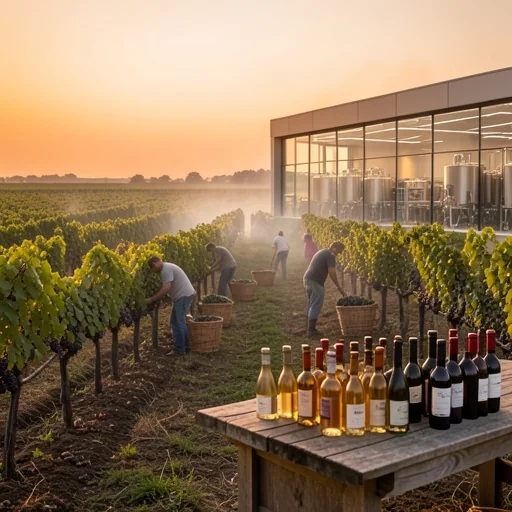
The contemporary harvest coexists with new overlapping urgencies: rapid grouping of ripening, widespread fires that contaminate grapes and consumers who select wine based on hue. From the appellation to the label, the wine industry must adapt harvesting, analysis and commercial strategy to hold quality and market together. Harvest timing now overlaps multiple urgent pressures.
Compressed vine and reorganization of priorities in the cellar
In the Hérault department the weekly bulletin of ICV, the regional technical center of the Institut Coopératif du Vin in Hérault, reports that harvests are “well underway” after a start on 6 August and a note on 13 August. The pressure of heatwaves has compressed ripenings. A Souvignier Gris rose from 10.5° potential to 13° in two days. This example shows how rapid change upends the traditional order between whites, rosés and reds. A cooperative cited the target of picking 600 tonnes a day but has a pressing capacity of 200 t/day; this imbalance forces clear choices on which lots to vinify first. Compressed ripenings force choices on lot priorities.
Water stress causes berry weight loss and must concentration. Technicians report a likely drop in acidity and malic acid. Responses in the cellar include biological acidification, addition of exogenous acid or use of ion-exchange resins after winemaking. On the phytosanitary front the frequency of botrytis and Aspergillus is increasing in coastal fringes. Forecast rains can overturn ripening and favor molds. Therefore it is prudent to include analytical thresholds and delivery-time clauses in commercial agreements.
The harvests are compressed by heatwaves. Biological acidification is a practical cellar response.
How smoke transforms agronomic and technological decisions in the wine industry
In 2026 87,000 hectares burned, an extent that puts large vineyard areas at risk. Dubernet laboratories, a private lab specialized in wine chemistry, formalized practical criteria to assess smoke taint risk. The key measure is glycosylated compounds: between 100 and 200 ppb the risk is very significant. Above 200 ppb contamination is critical and often makes harvesting pointless. Distance from the fire front is an operational indicator. Samples collected between 100 and 500 meters from the front were predominantly at risk. Beyond 500 meters, and up to 1 kilometer in favorable wind conditions, risk falls markedly.
Dubernet also distinguishes hot and cold smoke. Hot smokes deposit guaiacols, eugenol and syringol on skins and cause the problem. Cold smokes, which travel for tens of kilometers, rarely cause significant contamination. Analysts recommend rigorous sampling. Burnt rows and the next five rows must be removed before sampling to obtain representative values. Relief and wind direction must be considered. It is necessary to measure glycosides in grapes, because tasting the berry often does not reveal the real risk.
Glycosylated compounds are the key measure for smoke taint risk.
The glycosylated compounds indicate smoke risk. Measure glycosides because tasting often misses contamination.
From the cellar to the market: treatments, limits and the role of wine color
When lots remain below the critical threshold, options in the cellar are concrete but require equipment and protocols. Tests on syrah and grenache indicate very short macerations, 5-6 days, to limit extraction of smoke compounds. Treatment with activated carbon is effective: AO carbon removed about two thirds of free phenols in tests. Granucol GE, a granular adjunct based on carbon used on musts at 60 g/hl in comparative trials, removed about half of the glycosylated compounds. For more severe cases the technical solutions are reverse osmosis followed by carbon adsorption or passage over resins. These solutions require membrane threshold adjustment, volumes treated and precise timing based on preliminary analysis. Activated carbon effectively reduces free phenols.
These choices must be clearly communicated to buyers. Distributors and restaurateurs must request analytical reports with clear thresholds such as 200 ppb and validated sampling protocols. Producers must document every intervention. Meanwhile color plays an outsized role in the market. Research by Aldi UK shows that 23% of British adults choose a rosé only based on its shade. 31% have already refused a glass because the hue did not match expectations. For the distributor these refusals are worth £103 million, i.e. €121 million in lost sales per year. The keychain shade guide launched by Aldi aims to reduce visual uncertainty. 56% of consumers consider hue an important purchase criterion.
The color of wine strongly influences the purchase decision.
The color of wine strongly influences the purchase decision. Consumers frequently reject wine for unexpected hue.
This link between color perception and the willingness to pay for risk demands precise commercial choices. A producer who must allocate lots for rosé, white or red must take into account compressed ripening, smoke risk and consumers’ chromatic expectations. Where smoke risk is low, blending with healthy lots or targeted use of oak can cover minor defects. Where risk is high, the most prudent practice remains not harvesting.
The next action will be the systematic integration of climate surveillance, standardized sampling and precise commercial communication. The question of industrial capacity remains open: without investment in rapid pressing, analysis and purification plants many choices will remain forced. Those who buy, distribute or serve wine must now treat these variables as negotiable criteria, not as seasonal surprises. Investment in pressing and purification is urgently needed.
Sources:
- Planning des vendanges bousculé entre “brusque hausse des degrés”… | vitisphere.com
- Un nuancier des vins rosés pour éviter 121 millions € de vente… | vitisphere.com
- À quelle distance des flammes le vin risque-t-il le goût de fumée ? | vitisphere.com
- Vendanger ou laisser tomber les raisins enfumés ? | vitisphere.com