Stories and news
Crisis in French wine: LVI restructuring and Saint-Sardos dormancy
The crisis is producing two opposite responses in the same market.
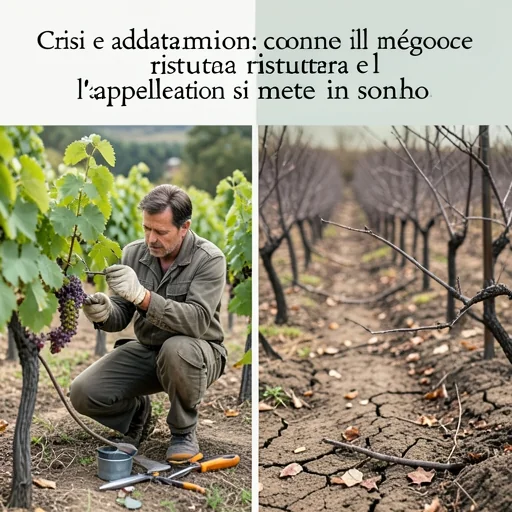
The crisis is producing two opposite responses in the same market. On one side a large négociant reorganizes companies, range and logistics to reduce costs. On the other, a small territory loses production and requests the dormancy of its AOC. The restructuring of the LVI group and the de facto closure of the AOC Saint-Sardos show how the wine supply chain reacts, economically and territorially.
Rationalize to survive in the viticulture crisis
The LVI group markets 15 million bottles, that is an industrial volume, with a turnover of 60 million euros. A corporate operation will merge three entities into one to reduce overhead costs. The move foresees a Transmission Universelle de Patrimoine that will create PJL SAS next January, with the objective of having a single stock, shared logistics and simplified administrative procedures. LVI sells 70% in large-scale retail, that is in supermarkets, and 18% to export. This concentration of channels drives the need for economies of scale.
LVI also disposes of non-strategic assets, including buildings and land. LVI intends to sell the Cheval Quancard bottling center, linked to the 2022 acquisition, to free up liquidity. The reduction of property assets serves to finance commercial innovation. The group expands its range with products designed for young, urban consumers. The group seeks to convert volume into brand preference.
The restructuring seeks to transform fixed costs into operating margins. The distribution channel conditions the production strategy.
Experiential products and marketing choices that respond to the crisis
LVI launches “Vin pour deux” in 50 cl bottles to win new consumers. The range includes three wines in IGP Pays d’Oc and a label with a QR code linking to musical playlists: rock for the red, salsa for the rosé and jazz for the white, with twelve tracks in each playlist. The group seeks to transform the bottle into a cultural and emotional experience. Under the “Life Style by PJL” umbrella illustrated labels are born in collaboration with tattoo artist Marty Early, and a marine line “Encre marine” is planned for the end of the year.
LVI also invests in low and non-alcohol products. Two references at 9 degrees, 20,000 bottles each, and 100,000 bottles overall for the non-alcohol variants. The group signs a two-year image contract with Matteo Soto, 21 years old, baton twirling champion, who will promote the Queralla brand. Soto will participate in the world championship in August 2027 in Liverpool.
Territory that withdraws: grub removal and the dormancy of the AOC
La Lomagne, an area between Tarn-et-Garonne and Haute-Garonne, experiences the other side of the crisis. The AOC Saint-Sardos did not produce red wine based on tannat and syrah in the vintage considered and requests the dormancy of the appellation. The cave of the Vignerons de Saint-Sardos was responsible for 97% of the AOC production. This dependency made the supply chain vulnerable when the cooperative stopped vinifying. Dependence on a single producer can nullify an entire denomination.
The cooperative was founded in 1955 and used to have 135 hectares in the past. In 2026 the situation was critical. The harvest yielded 16 hectoliters per hectare in a severely compromised vintage. In the area there remained only 8 winegrowers for the initial 38 hectares. The State allocated an uprooting incentive measure of 4,000 euros per hectare. The measure pushed many members to leave viticulture and relocate professionally. Incentive measures accelerate the abandonment of non-competitive vineyards.
Dormancy is a collective decision taken when productive potential falls below the useful threshold.
Practical consequences for buyers, restaurateurs and distributors
For importers and restaurateurs the implications are concrete and opposed. Large négociants like LVI offer stable volumes and new references for young consumers, thanks to 15 million bottles and consolidated channels. Large operators guarantee scale and range innovation. At the same time, the end of production in an AOC like Saint-Sardos shows that some denominations can become intermittent sources. They have the potential to drop to zero in a single vintage.
Assortment choice now requires a double analysis: assess the reliability of the territorial supply and the commercial compatibility of concept-driven products. Some producers resist and continue to invest in quality. Domaine La Tucayne has 7 hectares organic. The domaine converts part of the production into vin de France to keep the local cultivation alive. The next phase will depend on investments in the vineyard and on restructuring choices along the supply and commercial channels.
The crisis does not close all chapters: previous vintages of Saint-Sardos remain on the market and some territorial actors aim to preserve cultivation. The question remains open as to who will finance the recovery of the vineyard area. It also remains open which appellations will be considered vulnerable in the coming years.
Sources: