
Qvevri and tradition
French viticulture: contracts, uprooting and impact on importers
French viticulture is cracking. The fracture combines commercial disputes, cuts in purchases by major houses…
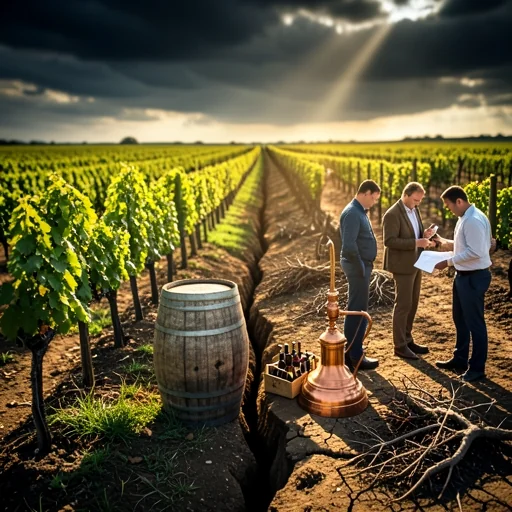
French viticulture is cracking. The fracture combines commercial disputes, cuts in purchases by major houses, public measures to reduce supply and climate shocks. This article explains how 45 winegrowers suing Sazerac, uprooting programs across 28,000 hectares, crisis distillation and the global abundance of labels affect those who import, distribute and serve wine.
French viticulture is cracking.
When a contract is worth more than liquidity in French viticulture
Forty-five winegrowers asked the commercial court of Angoulême to declare the termination of their contracts with Sazerac null and void. The winegrowers explain that bank loans are based on contracts and not on cash flows. In this litigation they demand that five-year contracts remain in force until 2029. They demand that three-year contracts remain in force until 2027 based on tacit extensions applied in 2024 and 2025. The stated objective is not compensation: they want market certainty for the time needed to sustain mortgages and the companies’ financing capacity.
To operate in the market you need to know the technical terms at first Distilled spirit is the distillation obtained from wine and wine merchants are the operators who buy, store and provide this raw material to the large houses. Sazerac’s defense said that its subsidiary accounts for less than 1% of distilled spirit purchases in Cognac. The defense pointed out that Hennessy reduced its purchases by 45%. The defense added that Rémy Martin cancelled 10,000 hl of pure alcohol, a cut that immediately affects supply flows. For an importer the lesson is practical: insert clauses guaranteeing volume stability or mechanisms for automatic reallocation of production.
The dispute highlights another operational point. Many contracts include termination clauses that can be triggered in economic crisis conditions. Suppliers must request written guarantees on purchase continuity or clauses that oblige the buyer to offer concrete alternatives. Buyers must also assess the concentration of sales: a quarter of the winegrowers involved say that 100% of their production went to a single customer, a condition that exposes the supply chain to the risk of immediate stoppage.
Uprooting, distillation and the reality of marketable supply
The plan to reduce productive potential has translated into requests for help with uprooting across 28,000 hectares with a contribution of €4,000/ha. At the end of August 20 of those 28 000 hectares were already out To unlock payments 5,700 ha were declared, that is requests for €23 million, with €18.5 million already disbursed. This cash flow aims to provide financial breathing room, but creates a logistical paradox: many vines destined for uprooting were nevertheless harvested in 2026.
Crisis distillation received applications for 673,445 hl of red and rosé wines. The program has an allocated budget of €22.22 million while the European target was 1.2 million hl. Withdrawals temporarily reduce the supply available on the market, but do not guarantee a structural price increase if demand remains weak. For a buyer this means that short-term volumes can vary greatly. Annual assortment planning must include scenarios of scarce availability.
The aid mechanism has practical timing and constraints that affect logistics. uprooting aid is paid after the declaration of uprooting and the operation may require cash advances to pay contractors. Many winegrowers report that the per-lot cost for the work reaches €1,000/ha and that contractors ask for 50% deposits. This explains why some producers harvest before uprooting and why the forecast for 2027 supply remains uncertain.
Climate, a fragmented market and what changes for buyers
Authorities indicate that 65% of the territory faces drought with a frequency estimated at once every 25 years. Authorities report that in many areas yield losses are 50% or more, with local peaks up to 70-80%. Fifty-seven departments have identified viticulture among the most affected productions. This picture pushes institutions to prepare measures worth “several hundred million euros”. This context fuels the industry’s request for a “blank year” that would suspend bank installments and social charges instead of offering new loans.
On the demand side, consultant Robert Joseph recalls that there are at least 1,000,000 labels worldwide. Robert Joseph warns that this overabundance fragments commercial channels and forces the selection of profitable ranges. Joseph also cites the sale of 10 volume brands from the Pernod-Ricard group as an example of divesting from less valued segments. For importers this means preferring suppliers with a brand strategy and the ability to concentrate supply.
The operational result for restaurateurs, sommeliers and distributors is clear. Three concrete actions are needed. Request contractual clauses that guarantee continuity of purchase. Limit exposure to a single supplier and obtain climate adaptation and commercial plans from partners. The rulings in the Sazerac case, the closure of distillation payments by October and the effectiveness of public measures will decide the extent of supply in 2027. Meanwhile, French viticulture remains a market where planning with data and clauses has become more important than relying on customary supply relationships.
Sources: