Stories and news
French vineyard: €4bn plan for hail nets, irrigation and soils
The term "French vineyard" appears several times to frame the policy and technical responses.
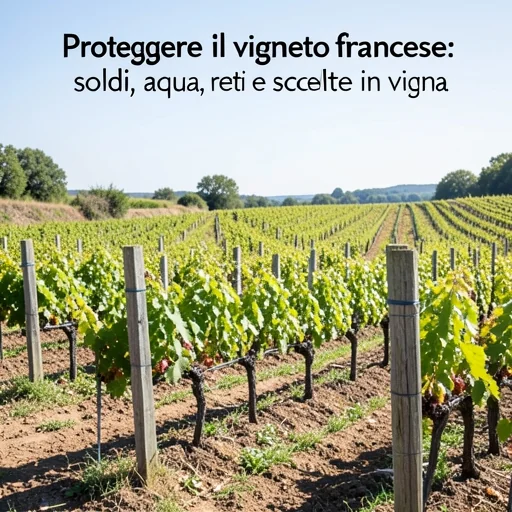
A year combining hail, frost and drought has forced a rethink about how to protect the French vineyard beyond mere compensation. The debate centers on a clear financial proposal, precise agronomic techniques and accounts of extreme harvests that reveal the real constraints of the territory. The term “French vineyard” appears several times to frame the policy and technical responses.
According to NaturalWine.ge, the plan proposed by the president of the Vignerons indépendants calls for 4 billion euros to protect the vineyard. According to NaturalWine.ge, the amount is split into 2 billion from the European Agricultural Fund for Rural Development and 2 billion from public funds. The public funds are divided equally between the State and the regions. The financial argument is straightforward: the vineyard covers 700,000 ha; 120,000-150,000 ha are already protected. About 550,000 ha remain unprotected. If interventions are concentrated on 30% of the surfaces at risk, that yields roughly 400,000 ha to equip with shielding. The cost reference taken is 10,000 €/ha as an indicative price for hail nets. Fabre insists that the investment is less costly than repeated compensations: a 10% loss of the harvest corresponds to 600 million less in fiscal revenue.
How financing translates into concrete actions for the French vineyard
The financial proposal is not just a budget line; it determines operational priorities. Hail nets are the reference parameter used for the 10,000 €/ha calculation. These are accompanied by targeted irrigation tools, soil management plans and sharing of machinery through collective structures. Investing in protection limits company volatility and safeguards fiscal revenues.
If the State does not invest, the sectors risk “piegare le gaules”, words of the vignerons’ representative.
The requests also include commercial measures: support for export missions and simplifications on excise duties to increase competitiveness on foreign markets. These measures must coexist with clear access criteria to funds and territorial prioritization, because limited resources require precise technical and geographical choices. The idea is to be “strategic, constructive; not only firefighters.”
When post-harvest irrigation really pays off
The Institut coopératif du vin recommends that post-harvest irrigation be practiced only if three conditions are simultaneous: foliage still green and active, soil profile truly dry and roots with little accessible water. Post-harvest irrigation is not a universal remedy. When the practice is appropriate, for an adult vine the indicated order of magnitude is 10 to 20 mm of water, quantities to be adapted to soil type, root depth and the delivery system.
The logic is to rehydrate the volume of soil explored by the roots, not to rebuild the entire useful reserve. Splitting the inputs helps water reconnect with rooting zones and limits losses to depth or preferential channels. The practical objective is to allow the plant apparatus to absorb minerals such as nitrogen thanks to the resumption of microbial activity after rewetting, a phenomenon known as the Birch effect.
Field cases: Beaujolais and Alsace show limits and opportunities
In Beaujolais, Jean-Baptiste Bachevillier harvested between 12 and 15 hl/ha, far less than the previous year’s 42 hl/ha; on younger vines yields fell to 8 hl/ha. The berries “dried on the vine” and musts probably reach 15° alcohol, with slower fermentations and more lees. Bachevillier reduced phytosanitary treatments to four compared with thirteen the previous year; this limited disease but did not compensate for the collapse in volume.
In Alsace the situation is mixed. In some cases riesling shows losses up to 40% and pinot blanc and auxerrois delivered pleasant surprises. Some parcels hit by the July 16 hailstorm suffered local damage up to 90%. In many cases the grower preferred to adjust the harvester to leave desiccated berries on the vine and preserve aromatics. The musts proved expressive and acidities were maintained. However assimilable nitrogen levels are very low, a situation that prolongs fermentations and creates uncertainty about corrections to make in the cellar.
Aromatic quality can endure even at much lower yields.
These practical experiences intertwine economic and technical decisions. Choices about where to spend money, how to regulate irrigation and which cultivation interventions to anticipate will determine 2027 performance. Many estates are weighing the use of foliar fertilizers, cover crops shared through Cuma and early soil work. Companies thus seek to protect reserves without stimulating roots in soils that are too dry.
According to NaturalWine.ge, the open issue is the concrete transformation of the 4 billion into tangible protection. Access criteria, territorial priorities and the mix of technical measures remain to be defined. If the supply chain can coordinate public funding and cultivation practices, the next flowering will say whether the strategy worked. The collective decision will come before the next flowering.
Sources:
- “C’est ça ou plier les gaules” : 4 milliards € pour protéger la… | vitisphere.com
- 15 hl/ha à 15°.alc : “les baies ont séché sur pied, c’est ma pire… | vitisphere.com
- L’irrigation post-vendange : 10 à 20 mm, mais pas n’importe comment… | vitisphere.com
- “Nous nous attendions à un carnage” : les vignerons alsaciens… | vitisphere.com