
Stories and news
Early harvest 2026 forces change in European wine production
The climate crisis is causing an unprecedented early harvest in 2026. The European wine sector faces complex challenges.
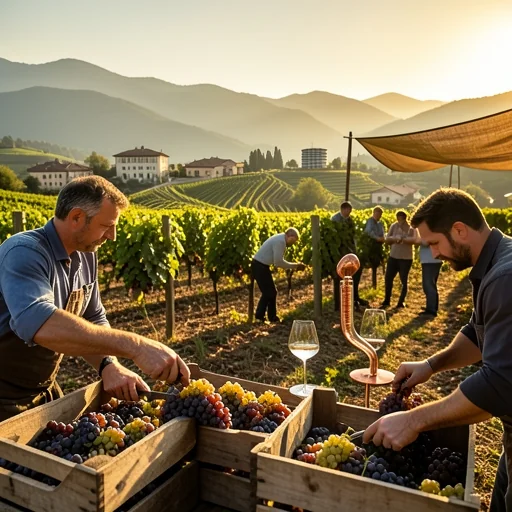
The European wine sector faces complex challenges. These challenges are reshaping practices established for centuries. Vegetative cycles are accelerating and weather conditions are extreme. Producers must rethink every stage of the process. The climate crisis caused an unprecedented early harvest in 2026. This raises questions about quality and production methods. New strategies and market adaptations are necessary. Winegrowers, from the Dordogne to South Tyrol, are facing unprecedented conditions. Rapid and innovative responses are needed. The goal is to preserve the identity and freshness of wines. The context goes beyond the purely climatic issue.
Climatic Challenges and the Delicate Balances of the Early Harvest
The summer of 2026 was among the hottest. Spring was also unusually mild. This accelerated the vegetative cycle ahead of time. In the French region of Bergerac and Duras, Cathy Lourtet reported a fourth heatwave. There was also a water deficit of 25–40% compared to the average. This situation caused a record early harvest in France. The picking for crémant and sauvignon blanc began on August 7. This is a significant advance compared with fifteen years ago, when it started in September.
In South Tyrol, the 2026 harvest is the earliest ever. This was confirmed by Eduard Bernhart, director of the Wine Consortium. Grapes for the base wines of traditional-method sparkling wine are already in the cellar. This rapidity requires managing delicate maturity balances. In Bergerac, malic acid levels are very low. Acidity rates are also falling sharply. Oenologist Christophe Veyssières warned that acidity correction will be crucial. Heat also degrades assimilable nitrogen. That is fundamental for fermentation and the aromatic development of wine.
Despite the challenges, there are positive signs. Sauvignons from Bergerac had good juice yields. A larger number of berries per cluster offset the lower weight. Reds, such as Merlot, are already reaching alcohol levels of 12.5–13.5%. However, aromatic and phenolic ripeness is still lacking. A harvest taken too early would be a choice driven by despair. Manual harvesting preserves grape health and quality. This is practiced in South Tyrol, with direct control over each cluster.
Irrigation and Adaptation: A Necessity between Regulations and Innovation
Irrigation is a key strategy against extreme conditions. In Alsace, the Colmar wine estate has demonstrated its effectiveness. They used a drip system in Clos Saint-Jacques. Pierre-Jean Fuchs applied two water inputs in April. These created a “wet bulb” around the roots. From June, additional supplies were given every six to eight days. They monitored evapotranspiration.
The results were “miraculous,” as described by Roxane Hardy, head of the estate. The grapes destined for crémant were harvested from August 11, with yields expected to reach 80 hectoliters per hectare. This is in stark contrast to the adjacent non-irrigated parcels.
The results were “miraculous,” said Roxane Hardy. The grapes for crémant were harvested from August 11. Yields should reach 80 hectoliters per hectare. This contrasts with the non-irrigated plots. The latter, on identical soil, might produce only fifteen hectoliters. The clusters were still closed in mid-August. Maison Cattin used a similar system. They noted that irrigated grapes have less hard skins and less bitter seeds. The juice-to-solid matter ratio is within the norm.
Access to water is the biggest challenge, said Arthur Froehly. Not all areas can easily access groundwater. Current regulations limit some changes. In Colmar, they would like to lower and widen the trellis plane. This would protect grapes from sunburn. But it does not fall within the appellation rules. Legacoop Agroalimentare highlighted that global warming affects hill areas. Strengthening irrigation infrastructure is necessary for hill areas.
Global Markets and Changing Consumption: The Future of Wine
The climate crisis is not the only challenge for the wine sector. Uncertainties about international markets and evolving consumption add to it. Cristian Maretti has called for rapid structural interventions from the Italian government. The goal is to protect producers’ incomes. US tariffs threaten a significant export market. These tariffs affect a market of €4.88 billion. This is 28% of the EU’s wine exports. Geopolitical tensions and rising energy costs complicate the context. The association has asked to suspend the planting of nearly 7,000 new hectares of vineyards each year.
Cristian Maretti, president of Legacoop Agroalimentare, has called on the Italian government for rapid structural interventions to protect producers’ incomes. Among the main concerns are US tariffs on European wines, which affect a market of €4.88 billion.
Despite the difficulties, there are rays of hope. Early positive feedback from the Brazilian market offers hope. The sector’s resilience depends on adapting to new consumer demands. A significant trend is the move toward red wines with lower alcohol levels. This pushes wineries to explore dealcoholized wines. The market for dealcoholized wines will grow substantially to $3.3 billion. This market is already worth more than $2.4 billion.
The intuition and experience of oenologists and winegrowers are essential. They are needed to face the early harvest and its implications. Maintaining the right level of acidity is key. This ensures freshness and elegance in wines. It is essential to meet market expectations. The future of Italian and European wine depends on managing climatic challenges. Embracing new trends will also be crucial. Defending the cultural and economic value of wine is vital.
Sources:
- Des monbazillac au chai dans 15 jours, “en même temps que les vins… | vitisphere.com
- L’Alsace se met à irriguer ses vignes, et “c’est miraculeux, avec… | vitisphere.com
- Alto Adige, la vendemmia 2026 è la più precoce di sempre | winemeridian.com
- Vino italiano tra crisi climatica e mercati: le sfide per il futuro | winemeridian.com