
Wineries
Wine production strategies: balancing yields, markets and precision
Wine production requires an integrated approach that balances yield management, commercial adaptation and targeted investments.
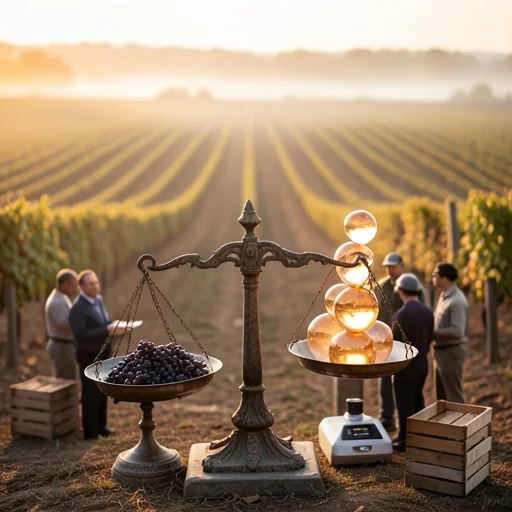
The wine sector, now more than ever, stands at a crossroads where strategic decisions are crucial. Wine production requires an integrated approach that balances yield management, commercial adaptation and targeted investments. Producers are navigating these pressures in different ways, from Anjou to the global markets for New Zealand Sauvignon Blanc in China, and to French cooperatives investing in precision. Limiting yields preserves commercial value.
Containing Yields and Wine Production to Preserve Value
The rosé producers of Anjou acted proactively for 2026, setting voluntary yield limits to counter falling prices. For Cabernet d’Anjou, yield was set at 50 hectoliters per hectare (hl/ha). This value is 10 hl below the production regulation, with a quality floor of 10 hl or an upper limit of 19 hl. These choices are a direct response to the decline in commercial offloads that has affected the appellation over the last three years. In 2023, only 270,000 hl were sold domestically, against a harvest of 350,000 hl. That gap caused a drastic fall in prices in 2024.
The logic behind these measures is that limiting yields preserves commercial value. Reducing supply is an essential lever to rebalance the relationship between stock and consumption. In Rosé d’Anjou, volume placed on the market fell from 125,000 hl in the 2020-2021 campaign to less than 90,000 hl in the 2024-2025 period. Interprofessional forecasts indicate 78,000 hl outflows by the end of July 2026, with stocks still equivalent to 10 months of sales, higher than needs. The winegrowers of Anjou stress that, faced with contracting sales, it is imperative to modulate supply to avoid further price collapses and restore a balance between demand and availability. This discipline sharply contrasts with what happened in other markets.
Reducing supply is an essential lever to rebalance the relationship between stock and consumption.
Stocks equivalent to ten months of sales remain, showing persistent imbalance.
The Impact of Global Markets on Prices and Positioning
The Chinese market offers a striking example of how volume growth can erode a wine’s premium positioning. In the first half of 2026, China imported 3,600,075 liters of New Zealand wine, marking a 59.94% increase compared with the previous year. The value of these imports rose by 18.55%, reaching 23.53 million dollars. Despite this significant volume increase, the retail price of Marlborough Sauvignon Blanc collapsed. Bottles that once signified elegance are now priced at 39.90 renminbi, about 5.13 euros. Such a price level was unthinkable just a few years ago for wines from that region.
The increase in volumes can depress prices, as shown by the New Zealand case. Volume growth can erode premium positioning. The abundance of supply stems from technical and commercial factors. The 2025 harvest in New Zealand was exceptional, with about 521,000 tonnes of grapes picked, a 31% increase over the previous year. Some companies opted to bottle locally or sell bulk wine to clear stocks. This also happened because the United States introduced a base tariff of 10% on many imported goods in April 2025. That strategy increased volumes and consumer access. However, it also diluted the product’s premium reputation, especially when distribution channels adopt aggressive pricing or private labels.
The commercial effect of these choices is clear: local bottling has diluted the premium reputation.
The “Hand-Sewn” Harvest and the Need for a Targeted Commercial Approach
In the south of France, winegrowers describe 2026 as a “hand-sewn vintage,” a tailor-made year. Differences between irrigated and non-irrigated plots are very marked. Grapes in some areas were harvested before August 15, while elsewhere ripening stalled. This heterogeneity produces a wide range of aromatic profiles. It requires precise operational management: each batch must be matched to its appropriate commercial destiny. This includes lighter, aromatic or more structured wines, directed to the channel that best values them. This approach is crucial to avoid the fire-sale scenarios that hit other markets, such as the New Zealand one in China.
Every batch must be matched to its destiny. This strategy demands constant dialogue with buyers and discipline in sales. Local advisors recommend holding 15% deposits on spot sales (immediate transactions) to protect cellar cash flow. It is essential to build medium-to-long-term relationships with buyers to define extremely precise wine profiles. The goal is clear: in a context of fragile treasury, selling well means understanding the consumer. It is about knowing who will pay the right value for a specific wine profile. Subsequently, winemaking processes must be adapted to keep that commercial promise. This requires flexibility and the ability to respond to increasingly detailed buyer briefs.
Keeping deposits protects cellar liquidity.
Investing in Precision for High-Quality Wines
While some producers reduce supply, other organizations invest significantly to offer precision and bespoke services. The cooperative Les 3 Grappes, for example, allocated 1.4 million euros for 2026. These funds are destined for a new stainless-steel tank room of 8,400 hl and a fifth press. The goal is to manage more differentiated lots and respond more accurately to client needs. The cooperative, which averages 105,000 hl harvested over 1,328 hectares, already has 90% of its 2026 volumes reserved. This model has kept remuneration for its 240 members unchanged over the past three years, demonstrating the sustainability of a market-oriented approach.
Investing in precision allows better market alignment. The new tank room, a set of vats and winemaking lines, is equipped with twelve refrigerated and automated stainless-steel compartments. This increases blending options and temperature control. The new Bucher XPert Extraflow press of 450 hl, the company’s fifth, can process up to 350 tonnes of white or rosé grapes per day. Les 3 Grappes anticipates further investments for 2028, about 1 million euros, for isothermal tanks (300 hl tanks that maintain constant temperature). These will be dedicated to the storage of aromatic wines. This technical capacity allows the market to be offered wines more aligned with buyer briefs, reducing the risk of fire-sales and creating a “tailor-made bulk” proposal that can support better prices without sacrificing volumes, a solution that balances the challenges seen in Anjou and the Chinese market.
Technical capacity and commercial precision are necessary conditions to support better prices.
Technical capacity reduces the risk of fire-sales.
The future of wine production will depend increasingly on the ability to balance yield, winemaking type and sales channel. The challenge is not just to produce less or more, but to ensure that every liter produced finds a buyer willing to pay the value that product expresses, in a market that rewards specificity and targeted quality. Every liter must find a buyer who will pay.
Sources:
- Les vins rosés réduisent les rendements pour relever les prix | vitisphere.com
- Cina, il Sauvignon Blanc di Marlborough crolla a 5 euro: scatta la… | winemeridian.com
- Un millésime “cousu main” où chaque raisin doit trouver sa place… | vitisphere.com
- Quand la crise viticole pousse des caves au repli, celle des 3… | vitisphere.com