
Regions and grapes
Rkatsiteli: the white grape that turns amber
Origin, character and styles of Rkatsiteli, Georgia's most widely planted grape: fresh white or amber in qvevri, with three versions to taste.
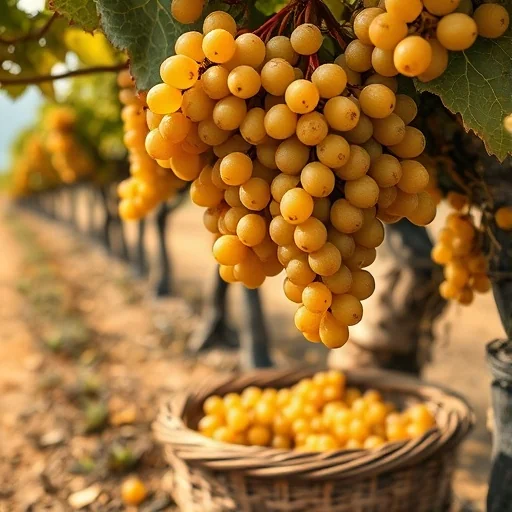
From mid-September, in the vineyards of Kakheti, the great wine region of eastern Georgia, Rkatsiteli reaches full ripeness. It is the moment when the country’s most widely planted grape enters the cellar, and from there it can take two paths: a fresh white or an amber wine, macerated for a long time on the skins in qvevri, the buried terracotta jars of the Georgian tradition. For anyone who drinks Italian skin-contact whites, Rkatsiteli shows clearly how the same grape can make very different wines.
A Kakheti native, the most planted grape in Georgia
Rkatsiteli is a native Georgian white grape and belongs to the group of Kakheti varieties. According to the National Wine Agency, Georgia’s national wine authority, it is the country’s leading grape by vineyard area. It is grown mainly in Kakheti and Kartli and is also cultivated outside Georgia, in Ukraine, Moldova, Armenia, Azerbaijan, Central Asia and Eastern Europe. The agency’s Japanese website explains that in Georgian the name means “red stem”.
Rkatsiteli goes into several wines with a protected designation of origin, including Tsinandali, Gurjaani, Kardenakhi, Kakheti, Kotekhi, Napareuli, Tibaani and Vazisubani, and since 2020 into Tsarapi, the designation dedicated to Rkatsiteli. In Kardenakhi, the Japanese factsheet notes, it is made into a fortified wine; otherwise it is mainly a still, dry white.
Character: cold, acidity and a discreet aroma
The agency’s factsheets describe a late-budding grape that resists cold well enough to endure the harsh Caucasus winters. It also resists diseases such as downy mildew, but eastern Georgia suits it better than the warm, humid west. It ripens between mid-September in Kakheti and early October in Kartli.
Acidity is high and, according to the Japanese factsheet, holds up even in hot summers. The Georgian factsheet gives the must a sugar content of 20 to 24% and an acidity of 7-8 g/l. The aroma, by contrast, is restrained, which is why Rkatsiteli is sometimes blended with Mtsvane Kakhuri, a more aromatic Georgian white.
Genetics has looked at it too. In 2017 a study published in Molecular Genetics and Genomics by Tabidze and colleagues, from the Agricultural University of Georgia and the University of Illinois, resequenced the genomes of four Georgian grapes from different haplogroups: Chkhaveri, Saperavi, Meskhetian green and Rkatsiteli, with Pinot Noir as the reference. Rkatsiteli’s nuclear DNA showed the most differences from the reference, 5,011,513 nucleotides against 2,174,995 for Saperavi. The figure applies to the sampled cultivars and says nothing about the wine in the glass.
Fresh white or amber: two styles from one grape
According to the National Wine Agency, Rkatsiteli makes excellent wines both with European-style winemaking and with the traditional qvevri method. For the European style the agency describes aromas of citrus, apple and quince, fresh acidity and a light to medium body. For the qvevri style it speaks of apricot, orange, persimmon and loquat, a measured phenolic presence and a medium to full body. These are descriptors of the grape, not tasting notes for a single bottle.
The traditional style comes from long fermentation on the skins. In a 2019 study in Acta Alimentaria, Bene and Kállay describe skin-contact whites, known as orange wines or qvevri wines, as wines from white grapes made with ancient Georgian techniques: the essence of the method is long skin-contact fermentation in amphorae, without chemicals or selected yeasts. In their work they measured the total polyphenols, catechins and colour intensity of these wines.
Three Rkatsiteli in qvevri, three interpretations
Etilika’s product sheets make it possible to follow the grape through three producers and three vintages.
- The 2025 Rkatsiteli from the Monks of Dariali comes from the Mtskheta-Mtianeti region, in the Dariali Gorge, at about 1,300 metres: according to the sheet it ferments in qvevri with three weeks of skin contact and matures in terracotta.
- The 2022 Rkatsiteli from Raberi comes from Kakheti, from alluvial soils rich in pebbles and limestone between 350 and 550 metres: the sheet lists hand harvesting, fermentation and maturation in qvevri, and 14% abv.
- The 2016 Tsarapi Rkatsiteli from Nagdi Marani comes from the Tsarapi microzone in eastern Kakheti, from clay and stony soils: according to the Etilika sheet it matures for three years in the same qvevri in which it ferments.
All three, according to the sheets, are made without added sulphites. Tsarapi also appears in research: the Institute of Viticulture and Winemaking of the Agricultural University of Georgia lists it, together with Napareuli, Mukuzani and Tibaani, among the microzones of a 2022-2025 project on the stilbenoid phytoalexins of Saperavi and Rkatsiteli, studied as an indicator of the vine’s resistance to disease. The institute’s page describes the project’s objectives, not its results.
Where to find it in Italy
According to the Etilika sheet, the Rkatsiteli Qvevri Orange Wine 2022 from Raberi is a dry white from Kakheti fermented and matured in qvevri. The Georgia Ambrata box brings together the three Rkatsiteli from the Monks of Dariali, Raberi and Nagdi Marani, to taste the same grape side by side across three vintages and three wineries.
Sources:
- National Wine Agency of Georgia (ღვინის ეროვნული სააგენტო): scheda… | wine.gov.ge
- National Wine Agency of Georgia, sito ufficiale giapponese: scheda… | georgianwine.jp
- Tabidze et al. (2017), Whole genome comparative analysis of four… | pubmed.ncbi.nlm.nih.gov
- Università Agraria della Georgia, Istituto di viticoltura ed… | agruni.edu.ge
- Bene e Kállay (2019), Polyphenol Contents of Skin-Contact Fermented… | real.mtak.hu
- Etilika: Rkatsiteli Qvevri Orange Wine Georgia 2022 - Raberi… | etilika.it
- Etilika: Box Degustazione “Georgia Ambrata” (3 bottiglie)… | etilika.it