
Qvevri and tradition
Qvevri: how Georgia's UNESCO-listed winemaking method works
A qvevri is not simply an amphora: it is a buried earthenware vessel in which wine can ferment and mature. Here is the process, what changes from one region to another, and how to read a bottle without stopping at the word on the label.
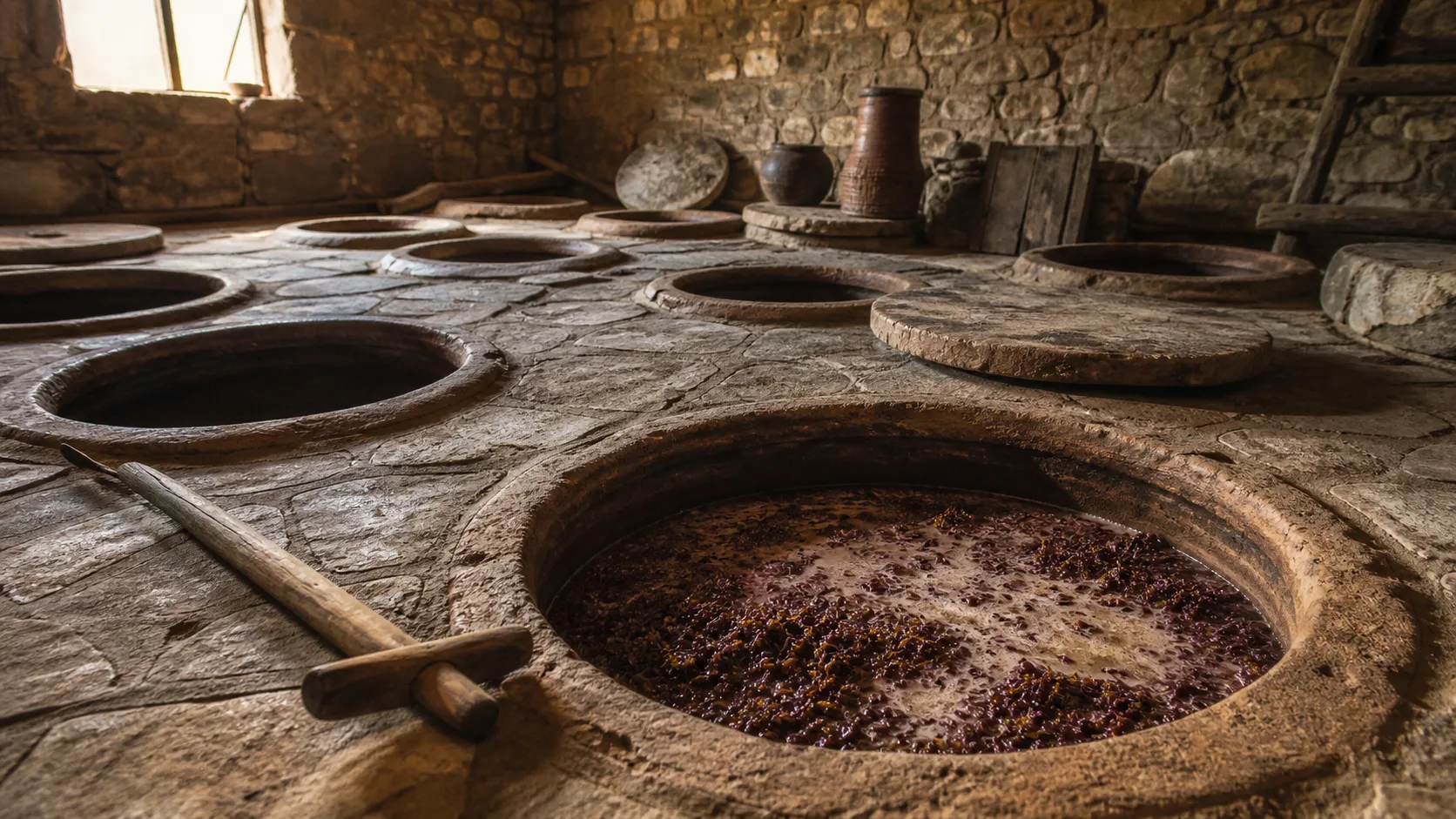
A qvevri is a buried earthenware vessel used to ferment and mature wine. The definition is simple; the method is not, because the amount of skins, inclusion of stems, maceration time and moment of racking vary between regions and wineries.
What truly identifies the method has to be kept apart from the usual shortcuts: qvevri does not automatically mean amber, natural or no-added-sulphite wine.
What a qvevri is and why it is buried
A qvevri is a large, egg-shaped earthenware vessel with no handles or flat base. It is placed in a pit and buried up to its neck; its opening remains accessible from the floor of the marani, the Georgian wine cellar, or from an outdoor winemaking area in some western Georgian traditions.
Burying it serves two practical purposes: it supports the vessel walls when full and moderates temperature swings compared with a jar kept above ground. Its shape also helps pips, skins and lees settle into the narrow bottom after fermentation.
Calling it an “amphora” is a useful shortcut only at first. A classical amphora often has handles and a shape also intended for transport or storage; a traditional qvevri is a winemaking vessel designed to remain underground. Capacity ranges from a few hundred to several thousand litres.
How qvevri winemaking works, step by step
The principle is to ferment and mature wine in the buried vessel, often with some of the grape solids. There is no single recipe. A typical cycle looks like this:
- Cleaning and preparation. Before harvest, the qvevri is emptied, washed and carefully checked. Earthenware is porous: some vessels are coated internally with beeswax, especially when highly porous, but waxing is not universal. The Elkana technical guide stresses hygiene because contamination can affect later vintages too.
- Crushing and filling. The must enters the qvevri with a chosen amount of chacha. Here the word means the solid parts of the grape — skins, pips and, depending on style, stems — rather than the spirit of the same name.
- Alcoholic fermentation. Yeasts convert sugar into alcohol. During the active phase, skins rise to form a cap that needs wetting and mixing. In its description of the traditional method, the National Wine Agency of Georgia notes frequent stirring, up to four or five times a day.
- Settling. As fermentation slows, skins, pips and lees sink into the tapered bottom. Clearer wine remains above, although this does not mean every finished qvevri wine is bottled unfiltered.
- Closing and maturation. Once the active phase is over, the qvevri is topped up and closed. The wine may complete malolactic fermentation and rest for weeks or months, with or without the pomace, depending on grape, region, vintage and winery decisions.
- Racking. The wine is separated from the settled solids. It may move into another qvevri for further maturation or into a different vessel before bottling.
Yeast and sulphite choices also remain with the winery. A qvevri can hold either a spontaneous or inoculated fermentation: the vessel alone does not define the intervention level.
What UNESCO actually inscribed
In 2013 UNESCO inscribed the Ancient Georgian traditional Qvevri wine-making method on the Representative List of the Intangible Cultural Heritage of Humanity. The official Decision 8.COM 8.13 refers to knowledge and skills associated with both winemaking and vessel-making, practised within communities and passed informally between generations.
The important distinction is this: UNESCO recognised living cultural heritage, not a product certification. It did not endorse a particular bottle, state that every clay-vessel wine is Georgian, or guarantee the quality of anything labelled “qvevri”.
Eight thousand years of wine does not mean eight thousand documented years of qvevri
An archaeological study published in PNAS found biomolecular evidence for grape wine in Georgia dating to about 6000–5800 BC. The same study distinguishes those large Neolithic jars from the earliest archaeological evidence specifically for qvevri winemaking, which it dates to the Iron Age.
It is therefore accurate to describe Georgian wine culture as extremely ancient. It is less accurate to turn “8,000 years of wine” into a proven, uninterrupted timeline of the identical modern qvevri.
Kakheti and Imereti: why two qvevri can produce different wines
The vessel material alone cannot predict the wine. The crucial difference is often how much chacha enters the qvevri and how long it remains in contact with the liquid.
| Aspect | Kakhetian method | Imeretian method |
|---|---|---|
| Area | Eastern Georgia | Western Georgia |
| Grape solids | Traditionally all the chacha | Usually a fraction, up to about one third |
| White wines | Contact can last from autumn until spring | Contact is generally more restrained |
| Tendency in the glass | More extraction, tannin and structure | Often a lighter, less tannic profile |
The distinction is documented by the National Wine Agency of Georgia, but it should not become a rigid formula. Grape variety, ripeness, stem percentage, temperature, duration and the individual winery can all shift the result significantly. Kartli, Racha, Guria and other Georgian areas have their own practices too.
What changes in the glass
For white grapes, skin contact creates the most visible signal. A white variety left for months with skins and pips can produce a golden, amber or tea-coloured wine, with more tannin and a texture closer to a red. The colour comes from extraction, not from the clay itself and not from an additive.
With reds, colour is less useful for identifying the method. Extraction, cap management, time on skins and maturation matter more. A Saperavi kept with pomace only through fermentation will differ from a white Rkatsiteli left on chacha until spring, even if both labels say “qvevri”.
A qvevri does not impart the toasted or vanilla aromas associated with a new oak barrel. That does not make every result identical to steel: shape, porosity, temperature and lees management all participate in the process, but their effect is difficult to separate from that of long skin contact.
Finally, earth, mould, volatile acidity and animal aromas are not proof of authenticity. A properly cleaned qvevri should not communicate a generic “vessel taste”. Rustic character and fault are not synonyms for tradition.
How to choose a bottle without stopping at the label
The word “qvevri” tells you where at least part of the winemaking happened, but not the whole story. Before buying, look at the technical sheet or ask the winery:
- which grape variety and region produced the wine;
- whether both fermentation and maturation took place in qvevri;
- how much chacha was used and whether it included stems;
- how long skin contact lasted;
- whether fermentation was spontaneous or inoculated;
- whether the wine was filtered and whether sulphites were added.
These answers are more informative than “amphora” or “qvevri” alone. They also prevent three misleading equations: qvevri equals orange wine, qvevri equals natural, and qvevri equals zero sulphites.
How to serve it and what to pair it with
There is no single serving temperature because “qvevri wine” describes a method, not a style. As a practical starting point, serve a structured amber white at around 12–14°C and a red at around 14–16°C; excessive chilling suppresses aroma and makes tannin feel harder.
Use a reasonably broad glass and taste before decanting. A short period of air can open a young or initially reductive wine; a mature or delicate bottle may lose definition quickly. Light sediment is possible in unfiltered wines and is not a fault by itself.
The structure of skin-contact whites works where a conventional white might feel too light: poultry, mushrooms, roasted vegetables, mature cheeses and spiced dishes. Pair reds according to grape, tannin and body, not according to the vessel.
Frequently asked questions
Qvevri or kvevri: which spelling is correct?
Both transliterate the Georgian word ქვევრი. We use qvevri because it is the spelling used by UNESCO and by the National Wine Agency of Georgia on its English-language pages.
Are a qvevri and an amphora the same thing?
Not exactly. «Amphora» helps describe a large clay vessel, but a traditional qvevri is egg-shaped, has no handles or flat base, and is designed to be buried and used for winemaking.
Are all qvevri wines amber or orange wines?
No. Amber colour comes from prolonged contact between white grapes and their skins. Qvevri are also used for reds, rosés and whites made with shorter skin contact or no long maceration.
Is qvevri wine always natural wine?
No. The vessel does not certify how the grapes were farmed or which yeasts, sulphites, filtration or other interventions were used. Check the technical sheet or ask the winery.
Is wine made in qvevri sulphite-free?
Not necessarily. Traditional qvevri winemaking can be low-intervention, but the vessel does not prohibit sulphite additions and does not mean «no added sulphites».
How long does the wine stay underground?
There is no single duration. In the Kakhetian method, white wines may remain on the pomace from autumn until spring; for many reds, contact with skins and pips lasts only through alcoholic fermentation. Grape, vintage and winery style all affect timing.
Should qvevri wine taste earthy?
No. Earthy notes may come from the grape or wine development, but mouldy or dirty-vessel aromas are not an essential feature of the method. The cleanliness of the qvevri and marani is critical.