
Regions and grapes
Ojaleshi: the light red of western Georgia
Ojaleshi, a rare red from western Georgia that once grew on the trees of Samegrelo: its history, how it compares with Saperavi and Ninos Marani's Ojaleshi.
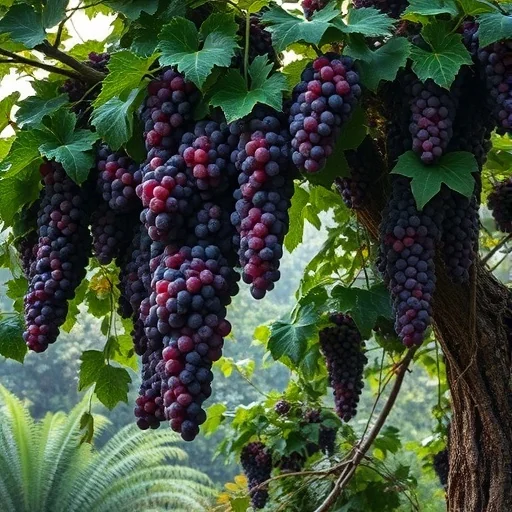
On the green hills of Imereti, in western Georgia, the rows of vines descend toward villages like Tsitelkhevi. In that village small wineries bottle wines from grapes almost unknown elsewhere. Among them is Ojaleshi, a red-berry grape variety that offers a light red, more delicate and fresh than the country’s better-known reds. Those who know Georgia only through Saperavi find a different perspective here. Ojaleshi offers less structure and more elegance. The question that accompanies anyone approaching these glasses is simple: Ojaleshi or Saperavi?
A grape variety that grew on trees
The name itself tells the story of its origin. Ivane Javakhishvili, Georgian academic and founder of Tbilisi State University, studied the term. According to his research, “ja” means tree and “oja-leshi” means a vine left to grow on a tree. In practice, Ojaleshi did not grow in rows: it climbed the branches of the persimmon trees of Salkhino, in Samegrelo. The birth of this variety is not identified in historical sources. But from its properties and its biological indicators it emerges as one of the oldest Georgian grape varieties.
The variety owes much to a family union. Prince Achille Murat, great-nephew of Napoleon I, emperor of France, married Salome Dadiani, a Georgian princess. Together they radically changed the course of viticulture in Salkhino. The two brought the vines down from the persimmon trees and arranged them in classic rows. They began producing that nearly forgotten variety and exported it to France. The wine produced by the Murats was also sold in Russia and Europe. The labels printed and sent to France are still preserved in the Dadiani palace.
The testimonies of those who tasted it
The red of Samegrelo left significant testimonies in the nineteenth century. Davit Dadiani, Salome’s father, wrote a sentence about the wine in a letter from 1852. He declared: “The first of all wines is Ojaleshi, which comes from the fruit of vines left to grow on the tall persimmon trees of Salkhino”. The French philologist Marie Brosset, a guest of the Dadianis at Easter 1848, went further and compared it to the great European reds.
“I cannot help comparing it to the best Bordeaux, because I know no other wine in Georgia that can stand up to the comparison, except that of Ateni”, Brosset explained.
Brosset added that on the whole Earth only Tokaji could be better. Jean Chardin, a French traveller, crossed Georgia in the seventeenth century and described the wine of Samegrelo as strong, dense and very pleasant to drink. According to georgia.travel, the export of Ojaleshi played an important role in deepening economic relations between Georgia and France in the nineteenth century.
Ojaleshi or Saperavi: how to choose
The most useful comparison is with Saperavi, Georgia’s main red grape variety. According to the profile of the Georgian national wine service, Saperavi is the most planted red in the country. It covers 10% of all plantings, more than 4,000 hectares. It is a teinturier variety: its wines are inky, often completely opaque, with pronounced tannins and considerable acidity, and alcohol between 12 and 14%. Ojaleshi follows another path. In its semi-sweet version it is a red table wine with a dark ruby colour, a delicate bouquet and a rich, harmonious taste. Today it is also produced in a dry version, a medium-bodied wine oriented toward red fruit.
Those looking for power and tannin choose Saperavi. Those who prefer delicacy and freshness find a different answer in Ojaleshi. The two ways of making red wine do not compete. Saperavi covers a range from dry to fortified, while Ojaleshi remains a rare variety tied to the west of the country. There, minor varieties like Dzelshavi and Otskhanuri Sapere coexist in the vineyards of small producers.
The right temperature at the table
Serving temperature matters for a red of this build too. According to the Wine & Spirit Education Trust, the “room temperature” suited to reds is 15-18 °C, much cooler than the conventional 20 °C; above 18 °C reds lose freshness and the structure of flavours becomes muddled. In its semi-sweet version, according to georgia.travel, Ojaleshi goes with traditional Megrelian dishes such as fried goat, kuchmachi and kupati, as well as fried pork stuffed with cheese.
Where to find it in Italy
Etilika sells the 2025 Ojaleshi by Ninos Marani, a winery in the Baghdati area of Imereti that, according to the listing, also grows Tsolikouri and Otskhanuri Sapere. The bottle is 0.75 liters. The listing suggests it for a tasting devoted to Georgian reds from native grapes, or to compare the Ojaleshi of Imereti with the wines of Kakheti. The full listing is on etilika.it.
Sources: