Market and export
Georgian wine balances global ambition and local challenges
The Georgian wine sector is experiencing a period of growing global attention, driven by its millenary history and distinctive production methods.
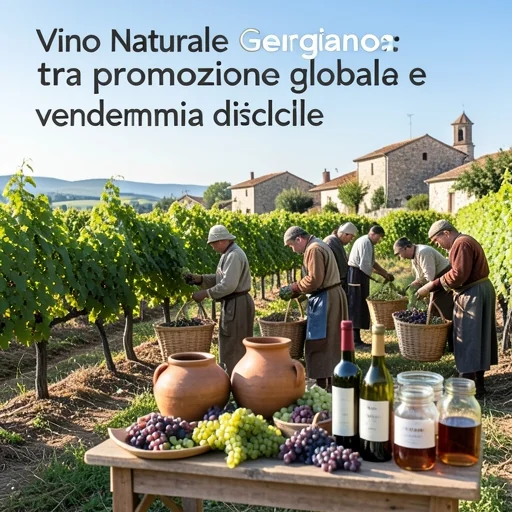
The Georgian wine sector is experiencing a period of growing global attention, driven by its millenary history and distinctive production methods, such as Natural Wine. The wineries are striving to establish themselves in international markets. The industry must tackle promotional opportunities while managing the complex realities of agricultural production and support for small winegrowers. This balance between global ambition and local roots defines the current path of Georgian wine.
The 2026 harvest in the Kakheti region proved particularly complex.
There was an effort to raise the profile of Georgian wine and encourage its export. For this reason, Georgian wine was the focus of a tasting on the German island of Sylt. The Agenzia Nazionale del Vino promoted the event with the support of ff.k Public Relations. The initiative aimed to present the product as an expression of unique winemaking traditions, addressing both sector professionals and German consumers. Sommelier Nils Lackner, a well-known figure in the German market, guided guests through various varieties, deepening the culture and specific characteristics of Georgian wines.
This internationalization effort extends to the recognition of indigenous varieties such as Saperavi, one of the most celebrated and characteristic Georgian wines. In October, the Saperavi International 2026 competition, hosted in Georgia, will see Andrew Jefford, the internationally renowned British journalist and writer and contributor to Decanter, preside over the jury. His participation stems from a long-standing professional interest in Georgian viticulture. It underlines the competition’s objective. The competition explores the diversity of Saperavi and its global prospects. It shows how a variety expresses itself in different styles and regions.
The Value of the Land and Support for Georgian Natural Wine
The complexity of Kakheti’s territory, the heart of Georgian wine production, is fundamental to the diversity of its wines. Regions such as Dedoplistskaro and Sighnaghi are located in the east. They benefit from a warm and dry climate. This climate favors early grape ripening. Areas such as Akhmeta and the northern part of Telavi present different climatic conditions. This is due to higher altitude. This variety of soils, altitudes and microclimates, combined with the influence of the annual weather, creates the singular characteristics that distinguish Georgian Natural Wine.
The Ministry decided to support those who work in these conditions. It exempted small wineries from paying the certification fee. This fee concerns alcoholic beverages intended for the local market. This relief was born from direct consultations. The consultations took place with representatives of small wine enterprises. It aims to promote the development of these businesses and to increase the competitiveness of Georgian wine. The measure is an important step to alleviate the financial burden on those who produce using traditional and small-scale methods.
Despite the exemption, certification remains a mandatory requirement for all producers. This policy ensures high-quality products on the market. It also guarantees consumer safety. These are crucial elements to maintain the reputation of Georgian wine. Reputation is important nationally and internationally. Attention to quality is a common thread that links promotional efforts to support policies, strengthening confidence in the product.
The 2026 Harvest: A Test of Resilience
The 2026 harvest in the Kakheti region proved particularly complex. Expert Giorgi Barisashvili described the year as “not good.” This is due to frequent and heavy rainfall. There was a strong incidence of fungal diseases and low sugar content in the grapes. These factors had a direct impact on the final quality of the product, making the season a real challenge for the region’s winegrowers.
Weather conditions directly influenced the government-set purchase prices for grapes. For Saperavi, for example, intact grapes with a minimum of 21% sugar were paid 1.50 lari per kilogram. However, if the sugar content fell between 17% and 21% or the grapes were partially damaged, the price fell to 0.90 lari. For grapes with less than 17% sugar or severely damaged, the value was reduced to only 0.30 lari, underscoring the crucial importance of optimal ripening.
The testimonies of local producers reflect these difficulties. Guram Maisuradze is from the Nadelebi winery in Telavi. He reported hail and intense rains. These events reduced the harvest by one third and caused flooding. This forced manual treatments in three hectares of vineyard. Davit Mosulishvili is from Marani Dano, in Machkhaani. He lost up to 80% of his Rkatsiteli crop. The cause was downy mildew and black rot. The remaining grapes nevertheless had a good average quality. Their sugar content was 21%.
Between Tradition and Future: The Sector’s Prospects
In Kvareli, winegrower Giorgi Chiaberashvili confirmed the difficulty of the year. Weather conditions were variable in spring and early summer. This required greater attention to disease management. Although the quantity of the harvest may be lower compared to previous years, the main objective remains the quality of the grapes. Producers eagerly await the achievement of the necessary sugar condition, hoping for an improvement in the climate.
Despite the challenges, the harvest process is organized. The coordination headquarters registered 280 wineries. These companies are ready to receive the grapes. Around 2,700 tons have already been processed mainly in the municipalities of Dedoplistskaro and Sighnaghi. The overall forecast for the Kakheti harvest is about 320,000 tons. The government established the Harvest Management Company to purchase surpluses from private parties, ensuring the full realization of the harvest even in the case of abundance.
The future of Georgian wine is played on multiple fronts. The ability to promote its uniqueness on international markets is needed. The resilience of producers in the face of difficult seasons and the continued support of institutions are crucial. The balance will be decisive for the future. It is necessary to enhance millenary traditions. It is also necessary to adapt to modern market and climatic needs. This will consolidate its position in the global wine landscape. Quality, forged by the hands of winegrowers and by the conditions of the land, remains the key.
Sources: