
Market and export
Documented Management for Wine Buyers Facing Climate Risk
Parcel maps, multi-year yield and ripeness records, insurance cover: which documents to ask a producer for, and how to read them as the climate shifts.
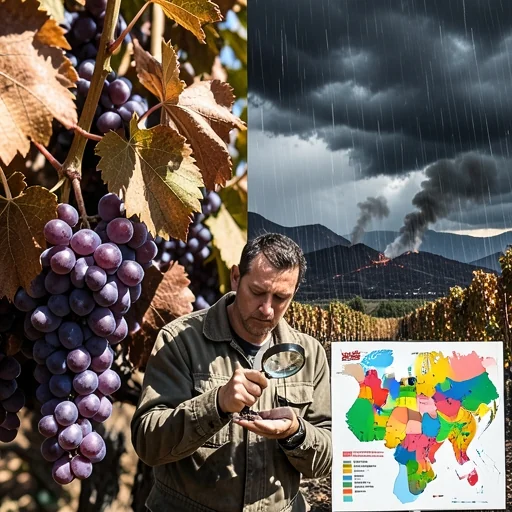
Requesting agronomic plans, exposure maps, data on surfaces and insurance coverages is the first thing an importer or sommelier should do today. Those documents must be read in light of the climate challenges that are altering ripeness, yields and even the geography of vineyards.
Concrete numbers and recent cases show how heat waves, violent rains, wildfires and parcel-level temperature variations impact quality and commercial risk. Credible due diligence starts from practical questions to ask suppliers.
The urgency of harvests and the variability of rainfall
The summer recorded 70 consecutive days above the norm and five heat waves. These conditions had visible consequences on harvests. In the Bordolese harvests began about 10 days earlier than in 2025. Whites were for the most part already in the cellar. Reds were harvested later. These accelerated rhythms affect commercial availability. They also influence the organoleptic notes that buyers and sommeliers must be able to interpret in the face of climate challenges.
Importers and sommeliers must request documented agronomic plans.
Precipitation occurred in a highly uneven way. Some plots received 40 mm in less than an hour. In Draguignan 80 mm fell. Late August rains do not normally swell the berries. They mainly serve to prevent further dehydration. For those buying wines it is useful to request the rainfall calendar by parcel and ripening data. These figures explain why alcohol degrees often remain high and why whites and reds show different profiles in the vintage.
Extreme weather accelerates or delays harvest timing.
Buyers should request rainfall calendar by parcel.
Documented management of parcels is essential to reduce commercial risk.
When the climate burns territories and economic models
A fire like the one in Trévillach burned across 4,936 hectares. It destroyed about 140 hectares of vineyard belonging to around twenty companies. Private fundraising has already collected €15,500 for domaine Gilles Troullier and €7,600 for Mas Moulin. An inspection estimated a single company’s loss at €150,000 for 6.5 hectares lost. The insurance policy reimbursed only €20,000, which is the contract cap. These figures measure the gap between real economic loss and insurance coverage.
Insurance payouts often do not cover actual losses.
The economic pressure is pushing a rethink of vineyard area. In Alsazia there is discussion of reducing 3,000 hectares over 30 to 50 years. As an initial proposal, 1,500 hectares could be phased out over several years. The goal is to concentrate resources on quality slopes. The vigneron who decides to reduce area does so for concrete reasons. Revenue from the must or bulk wine market may be insufficient. A smaller area allows reinvestment in sales and improves return per hectare. Those who buy or represent wines must therefore demand a five-year surface management plan and a replanting strategy.
Demand five-year surface management plans from suppliers.
Soil, practices and why there is no universal solution to climate challenges
Thermal surveys over 70 km2 in the Cahors area showed nighttime temperature variations with sharp parcel-level boundaries. The thermal patterns were so defined they seemed marked by tractor tracks. Vegetative ground cover is the decisive variable. It indicates whether the soil is 100% worked, alternate rows worked and not worked, or 100% cover cropped. Observation correlated three cover crop managements with three temperature classes during a frost night. This leads to practical rules. Soil with more water conducts heat better toward the air. Air in the soil insulates and favors rapid cooling.
Soil cover management directly alters parcel microclimate.
Polyphenols are the phenolic compounds that determine structure and color. Analyses of this vintage show average or low levels in many parcels. Heat and excessive water stress disturbed anthocyanin synthesis, the red pigments. Many berries remained with still-neutral aromas. Seeds did not fully brown. Night cooling can slow technological ripening. It can also give aromas time to develop. However it does not erase the effects of weeks of heat waves. Row refers to the vine row. The width of the inter-row and the management of the trellis affect local temperature and humidity.
Night cooling can improve aromas but not erase heat.
It is therefore wrong to think there is a universal practice that solves all risks. Working the soil to reduce frost risk can increase evaporation during heat waves. Scheduled mowing can limit water use by the vegetative cover but reduces shading. Buyers must ask suppliers to explain the trade-offs adopted and the effects on yields over the past three years.
Buyers must obtain transparency on the practical trade-offs adopted.
What to request concretely from suppliers: parcel maps with exposure and surface area per row, yield history and records of early harvests for at least three seasons, polyphenol and ripeness levels by batch, insurance policies with limits and deductibles, and a replanting plan with expected timing and costs. The next year will show who managed to adapt cultivation, investments and market strategy. The risk remains real, but documented management is the only way to turn uncertainty into a commercial choice.
Request insurance policies, ripeness data, and replanting plans.
Documented management is the only way to turn uncertainty into choice.
Sources:
- De la sécheresse aux orages, les vendanges changent de visage | vitisphere.com
- Réduire la surface du vignoble alsacien pour le rendre plus… | vitisphere.com
- “Les variations thermiques présentent des contours parcellaires… | vitisphere.com
- La solidarité s’organise pour replanter les vignes brûlées | vitisphere.com